Love this? Save it for later!
Share the inspiration with your friends
It was 11:47 PM on a rainy Thursday, and my sourdough starter—affectionately named “Bernice”—was staring me down from the counter. She’d been fed that morning, but I’d forgotten to plan my weekend bake. Now I had a jar full of bubbly discard and a gnawing hunger that wasn’t going to wait until morning. I didn’t have the energy for kneading or the patience for a complicated shaping routine. But I had a half-full bottle of olive oil, a sprig of rosemary that was starting to look sad, and a wild idea that maybe—just maybe—discard could do something it wasn’t supposed to do.
Honestly, I was skeptical. Focaccia is supposed to be that pillowy, cloud-like bread you get at fancy Italian restaurants, right? The kind that takes hours of folding and resting and praying to the gluten gods? But let me tell you, at midnight on a rainy Tuesday, you start breaking rules. I dumped the discard into a bowl, added some warm water and flour, and stirred until it looked like a sticky, lumpy mess. No kneading. No stand mixer. Just a wooden spoon and a prayer. I covered it with a damp towel and went to bed, fully expecting to find a flat, sad pancake in the morning.
What I found instead changed my entire relationship with sourdough discard. The dough had doubled, maybe even tripled—bubbling over the edge of the bowl like it was alive. It smelled tangy and yeasty, like a bakery in the middle of the night. I dimpled it with my fingers (okay, I got a little aggressive, but that’s the fun part), drizzled it with way more olive oil than I probably should have, and scattered those rosemary leaves across the top like confetti. Twenty-five minutes later, I pulled out a golden, crackling focaccia that made my tiny apartment smell like heaven. It was crispy on the bottom, airy on the inside, and had those perfect little wells of olive oil that catch salt and herbs. I ate a quarter of it standing over the counter at 12:30 AM. No regrets.
Maybe you’ve been there—staring at a jar of discard, wondering if it’s good for anything besides pancakes or crackers. I’m here to tell you, this easy no-knead sourdough discard focaccia with rosemary is the answer. It’s forgiving, it’s fast (for bread, anyway), and it turns your kitchen trash into treasure. Let’s make some.
Why You’ll Love This Recipe
I’ve tested this recipe more times than I’d like to admit—through humid summers, dry winters, and one particularly tragic batch where I forgot the salt. Trust me, I’ve made every mistake so you don’t have to. Here’s why this easy no-knead sourdough discard focaccia with rosemary belongs in your regular rotation:
- Quick & Easy: From bowl to oven in under 3 hours (most of that is hands-off rising time). Perfect for those days when you want fresh bread but don’t have all day.
- Simple Ingredients: Flour, water, salt, olive oil, rosemary, and your sourdough discard. That’s it. No yeast packets, no special flours, no trips to the specialty grocery store.
- Perfect for Discard: Finally, a recipe that actually wants your unfed, neglected starter. This focaccia thrives on that tangy, fermented flavor that discard brings to the table.
- Crowd-Pleaser: I’ve brought this to potlucks, dinner parties, and even a book club meeting. It disappears every single time. People fight over the corner pieces.
- Unbelievably Delicious: The contrast between the crispy, olive-oil-crusted exterior and the soft, airy interior is next-level comfort food. The rosemary adds that earthy, piney note that makes it feel fancy without trying.
What makes this recipe different from others? It’s the technique. Most focaccia recipes call for a wet dough that’s nearly impossible to handle without a bench scraper and years of practice. This one uses a slightly stiffer dough that’s still forgiving but actually manageable for beginners. Plus, the long cold fermentation (or quick room-temperature rise) develops that complex sourdough flavor without the fuss. I’ve tested this with active starter, discard straight from the fridge, and even starter that’s been sitting out for two days. It works every time.
This isn’t just another bread recipe. It’s the kind that makes you close your eyes after the first bite. It’s comfort food reimagined—faster, easier, but with the same soul-soothing satisfaction. Perfect for impressing guests without stress, or turning a simple Tuesday into something memorable.
What Ingredients You Will Need
This recipe uses simple, wholesome ingredients to deliver bold flavor and satisfying texture without the fuss. Most of these are pantry staples, which means you can make this easy no-knead sourdough discard focaccia with rosemary on a whim.
For the Dough
- All-purpose flour (3 cups / 375g) – I prefer King Arthur Flour for consistent protein content, but any brand works. Bread flour will give you a chewier texture; all-purpose keeps it tender.
- Sourdough discard (1 cup / 240g) – Unfed, straight from the fridge, or at room temperature. This is where that tangy flavor comes from. If your discard is particularly thick, you might need to add an extra tablespoon of water.
- Warm water (1 cup / 240ml) – About 90-100°F. Too hot will kill the natural yeast in your discard; too cold and the fermentation will take forever.
- Olive oil (¼ cup / 60ml, plus more for the pan) – Use a good quality extra virgin olive oil for the best flavor. I recommend California Olive Ranch for a balanced, not-too-peppery taste.
- Salt (1½ teaspoons / 9g) – Fine sea salt dissolves better than kosher in this dough. Table salt works too, but reduce to 1 teaspoon.
- Honey or sugar (1 teaspoon) – Optional, but helps with browning and gives the yeast a little boost. I use local honey when I have it.
For the Topping
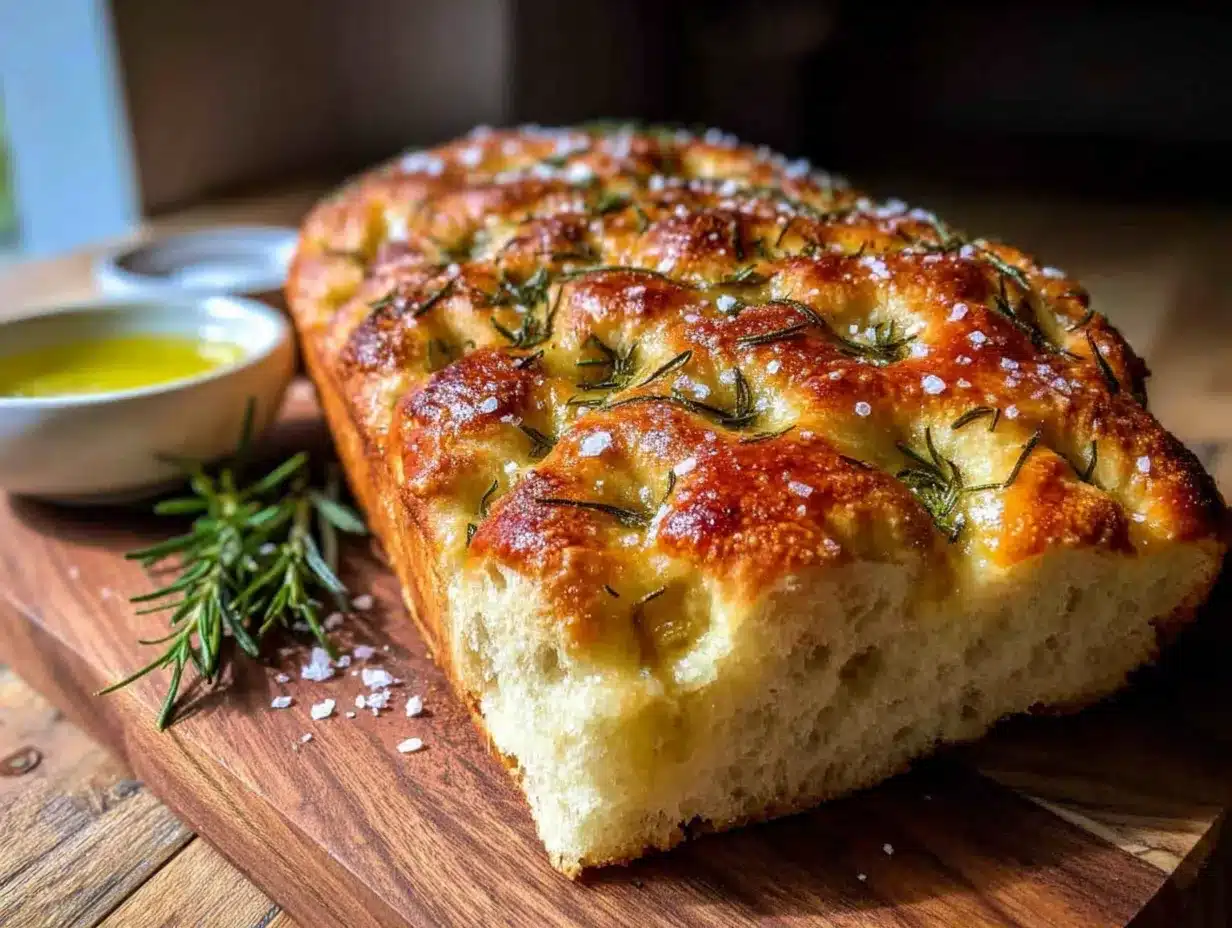
- Fresh rosemary (2-3 sprigs, leaves removed and roughly chopped) – Dried rosemary works in a pinch, but use half the amount. The fresh stuff really shines here.
- Flaky sea salt (1 teaspoon, for sprinkling) – Maldon is my go-to. The big crystals add that satisfying crunch.
- Extra olive oil (2-3 tablespoons, for drizzling) – Don’t skimp here. This is what creates that golden, crispy crust.
Ingredient Selection Tips: Look for rosemary that’s bright green and fragrant—if it’s brown or droopy, it’s past its prime. For the olive oil, you don’t need the most expensive bottle, but avoid the cheap stuff that tastes like nothing. A mid-range extra virgin makes a noticeable difference.
Substitution Guidance: For a gluten-free version, use a 1:1 gluten-free flour blend (I like Bob’s Red Mill) and add an extra tablespoon of water. The texture will be denser but still delicious. No honey? Use maple syrup or skip it entirely. No rosemary? Try thyme, oregano, or even everything bagel seasoning.
Equipment Needed
You don’t need a fancy kitchen to make this easy no-knead sourdough discard focaccia with rosemary. Here’s what you’ll need:
- Large mixing bowl (at least 4-quart capacity) – Glass or ceramic works best. Avoid metal bowls if your discard is particularly acidic.
- Wooden spoon or dough whisk – A sturdy spoon is fine. I actually prefer a dough whisk because it doesn’t get as gummed up.
- 9×13-inch baking pan – Metal or glass both work. Dark metal pans give a browner bottom crust. If using glass, reduce oven temperature by 25°F.
- Plastic wrap or a damp kitchen towel – For covering the dough while it rises.
- Measuring cups and spoons – A kitchen scale is more accurate, but cups work fine for this forgiving recipe.
- Bench scraper (optional) – Helpful for handling the dough, but not essential. I’ve used a butter knife in a pinch.
- Cooling rack – Lets air circulate so the bottom stays crispy.
Budget-Friendly Tip: Don’t have a 9×13 pan? Use a cast iron skillet or a round cake pan. The shape doesn’t matter—it’s all about the taste. I once made this in a pizza pan and it turned out perfectly fine, just a little thinner.
Preparation Method
Let’s get to the good part. This easy no-knead sourdough discard focaccia with rosemary comes together in a few simple steps. Trust the process—it’s more forgiving than you think.
Step 1: Mix the Dough (5 minutes)
In your large mixing bowl, combine the sourdough discard and warm water. Stir until the discard is mostly dissolved—it doesn’t need to be perfect. Add the olive oil, honey (if using), and salt. Stir again. Now add the flour all at once and mix with your wooden spoon until a shaggy, sticky dough forms. It will look lumpy and unappealing. That’s normal. Cover the bowl with plastic wrap or a damp towel and let it rest for 30 minutes. This autolyse step lets the flour absorb the liquid and makes the dough easier to handle later.
Step 2: First Rise (2-3 hours at room temperature, or overnight in the fridge)
After the rest, the dough will be smoother and slightly puffy. Leave it covered and let it rise at room temperature for 2-3 hours, until it’s doubled in size and bubbly. If you’re planning ahead, you can refrigerate it for 8-12 hours instead. The cold fermentation develops more flavor and makes the dough easier to handle. I’ve done both, and honestly, the overnight version tastes more complex—like something you’d get at a bakery.
Warning: If your kitchen is cold (under 68°F), the rise might take 4-5 hours. Be patient. The dough should look alive and full of bubbles when it’s ready.
Step 3: Prepare the Pan (5 minutes)
Drizzle about 2 tablespoons of olive oil into your 9×13-inch baking pan. Use your fingers to spread it all over the bottom and up the sides. Don’t be shy—this oil is what creates that crispy, golden crust. Gently scrape the risen dough into the pan. It will look like a deflated blob. That’s okay.
Step 4: Stretch and Dimple (10 minutes)
Here’s where it gets fun. Using oiled fingers (dip them in more olive oil), gently stretch the dough to fill the pan. Don’t pull too hard or you’ll tear it. If the dough resists, let it rest for 5 minutes and try again. Once it’s evenly spread, dimple the entire surface with your fingertips—press down firmly, almost to the bottom of the pan. You should hear a little squish sound. That’s the oil doing its job. These dimples are where the olive oil pools and creates those irresistible crispy spots.
Step 5: Second Rise (30-45 minutes)
Cover the pan with plastic wrap or a towel and let the dough rise again until it’s puffy and jiggly, about 30-45 minutes. It should look like a soft pillow. While it rises, preheat your oven to 425°F (220°C). Position a rack in the middle of the oven.
Step 6: Top and Bake (25-30 minutes)
Once the dough is puffy, drizzle another 2-3 tablespoons of olive oil over the top. Use your fingers to spread it into all those dimples. Sprinkle the chopped rosemary evenly across the surface, followed by the flaky sea salt. Bake for 25-30 minutes, rotating the pan halfway through. The focaccia is done when it’s deep golden brown on top and sounds hollow when you tap the bottom. If the top is browning too fast but the bottom isn’t done, tent it with foil for the last 5 minutes.
Sensory Cue: Your kitchen will smell like an Italian bakery. The edges should be crispy and caramelized, and the top should have those beautiful golden-brown dimples filled with glistening oil.
Step 7: Cool and Serve (15 minutes)
Let the focaccia cool in the pan for 5 minutes, then transfer it to a cooling rack. Don’t skip this step—if you leave it in the pan, the bottom will get soggy. Let it cool for at least 10 more minutes before slicing. I know it’s tempting to tear into it immediately, but the texture improves as it sets. Serve warm or at room temperature.
Cooking Tips & Techniques
After making this easy no-knead sourdough discard focaccia with rosemary at least twenty times (I’m not exaggerating), I’ve learned a few things the hard way. Here are my best tips:
Don’t overmix the dough. I know it’s tempting to keep stirring until it’s smooth, but stop as soon as the flour is incorporated. Overmixing develops too much gluten and makes the focaccia tough instead of tender. Lumpy is good. Lumpy means you haven’t ruined it yet.
Use room temperature discard. If your discard is straight from the fridge, let it sit out for 30 minutes before mixing. Cold discard slows down fermentation and your rise will take forever. I learned this the hard way when I made a batch that took 6 hours to double.
Don’t skip the dimpling. This isn’t just for looks—the dimples create pockets for the olive oil to pool, which creates those crispy, caramelized spots that everyone fights over. Press firmly and don’t be afraid to go deep. I once had a friend who barely dimpled her dough and ended up with flat, oily focaccia. Learn from her mistake.
Watch the salt. Flaky sea salt is not the same as table salt. If you’re using table salt for the topping, use half the amount. Too much salt can kill the yeast activity and leave you with dense bread. I once used kosher salt thinking it was flaky, and the focaccia was so salty it was almost inedible. Almost.
Let it cool completely before storing. If you wrap it while it’s still warm, the steam will make the crust soggy. Trust me, I’ve made this mistake more times than I’d like to admit. Patience, my friend.
Variations & Adaptations
This easy no-knead sourdough discard focaccia with rosemary is incredibly versatile. Here are some variations I’ve tried and loved:
Garlic & Herb Focaccia
Add 3-4 cloves of minced garlic to the olive oil before dimpling. Sprinkle with dried oregano and thyme along with the rosemary. The garlic gets sweet and mellow in the oven—it’s absolutely addictive.
Everything Bagel Focaccia
Skip the rosemary and sprinkle everything bagel seasoning (sesame seeds, poppy seeds, dried garlic, dried onion, salt) over the top before baking. This version is dangerously snackable. I’ve eaten an entire pan in one sitting. No regrets.
Roasted Tomato & Basil Focaccia
Press halved cherry tomatoes into the dimples before baking. Add fresh basil leaves after baking. The tomatoes burst in the oven and create little pockets of jammy sweetness. This is my summer go-to.
Dietary Adaptations: For a dairy-free version, this recipe is already dairy-free (olive oil instead of butter). For a lower-carb option, substitute 1 cup of almond flour for 1 cup of all-purpose flour—but note that the texture will be denser and more cake-like. For a vegan version, skip the honey and use maple syrup or agave.
Serving & Storage Suggestions
This easy no-knead sourdough discard focaccia with rosemary is best served warm, straight from the oven, but it’s also delicious at room temperature. Here’s how to make the most of it:
Serving Temperature: Warm or room temperature. If you’re serving it later, reheat in a 350°F oven for 5-7 minutes. Skip the microwave—it turns the crust rubbery.
Presentation Ideas: Cut into squares or strips and arrange on a wooden board. Drizzle with a little extra olive oil and sprinkle with fresh rosemary. Serve alongside soup, salad, or pasta. It’s also fantastic as a sandwich bread—slice it horizontally and stuff with roasted vegetables, mozzarella, and pesto.
Complementary Dishes: This focaccia pairs beautifully with tomato basil soup, minestrone, or a simple arugula salad with lemon vinaigrette. For a heartier meal, serve with roasted chicken or grilled vegetables. And of course, a glass of red wine never hurts.
Storage Instructions: Store in an airtight container at room temperature for up to 3 days. Do not refrigerate—it will dry out the bread. For longer storage, wrap tightly in plastic wrap and freeze for up to 3 months. To thaw, leave at room temperature for 2 hours, then reheat in the oven.
Flavor Development: The flavor actually improves after a day. The sourdough tang becomes more pronounced, and the rosemary infuses throughout. I’ve been known to make a batch on Sunday and nibble on it all week.
Nutritional Information & Benefits
While this easy no-knead sourdough discard focaccia with rosemary is definitely a treat, it does have some redeeming qualities:
| Nutrient | Per Serving (1/8 of recipe) |
|---|---|
| Calories | 220 |
| Total Fat | 10g |
| Saturated Fat | 1.5g |
| Carbohydrates | 28g |
| Fiber | 1g |
| Protein | 4g |
| Sodium | 380mg |
Health Benefits: Sourdough fermentation breaks down some of the gluten and phytic acid in wheat, making the nutrients more bioavailable. The olive oil provides healthy monounsaturated fats and antioxidants. Rosemary is rich in antioxidants and has anti-inflammatory properties. Plus, using sourdough discard means you’re reducing food waste—a win for your wallet and the planet.
Dietary Considerations: This recipe is dairy-free, nut-free, and can be made vegan by substituting the honey. It contains gluten, so it’s not suitable for celiacs without using a gluten-free flour blend.
Conclusion
This easy no-knead sourdough discard focaccia with rosemary has become my go-to recipe for so many reasons. It’s forgiving enough for beginners, impressive enough for guests, and uses up that pesky discard that always seems to accumulate in the fridge. The combination of crispy, oil-crusted edges and soft, airy interior—studded with fragrant rosemary and flaky salt—is honestly hard to beat.
I love that this recipe doesn’t demand perfection. Some batches turn out puffier than others. Sometimes the rosemary burns a little on the edges. Sometimes I forget the salt and have to sprinkle it on after baking. It still tastes amazing every single time. That’s the beauty of focaccia—it’s rustic, forgiving, and always delicious.
I’d love to hear how yours turns out. Did you try a variation? Did you burn it and eat it anyway? (I’ve been there.) Drop a comment below and let me know. And if you’re looking for more ways to use up that sourdough discard, check out my sourdough discard crackers and easy sourdough pancakes—they’re just as forgiving and just as delicious.
Happy baking, friend. Your kitchen is about to smell incredible.
Frequently Asked Questions
Can I use active sourdough starter instead of discard?
Absolutely. If you use active starter, you might need to reduce the water slightly (about 2 tablespoons) since active starter is usually thinner. The rise time will also be shorter—check the dough after 1.5 hours instead of 2-3.
My dough isn’t rising. What went wrong?
Several things could be happening. Your discard might be too old or weak—if it hasn’t been fed in more than 2 weeks, the yeast might be dormant. Your kitchen might be too cold (under 68°F). Or your salt might have killed the yeast if you added it directly on top of the discard. Try moving the bowl to a warm spot (like near the oven or on top of the fridge) and give it more time.
Can I make this gluten-free?
Yes, but the texture will be different. Use a 1:1 gluten-free flour blend and add an extra tablespoon of water. The dough will be more like a thick batter than a traditional dough. It won’t rise as much, but it will still be delicious. I’ve made it with Bob’s Red Mill 1:1 and it turned out surprisingly well.
How do I get those big air bubbles in my focaccia?
The key is a wet dough and gentle handling. Don’t overmix, don’t punch down the dough too aggressively, and be gentle when stretching it into the pan. Also, a longer cold fermentation (overnight in the fridge) develops more gas and creates bigger bubbles. I get my best bubbles when I do the overnight version.
Can I freeze this focaccia?
Yes! Bake it completely, let it cool, then wrap tightly in plastic wrap and foil. Freeze for up to 3 months. To reheat, thaw at room temperature for 2 hours, then pop it in a 350°F oven for 5-7 minutes. It’s almost as good as fresh. I often bake a double batch and freeze one for later.
Pin This Recipe!
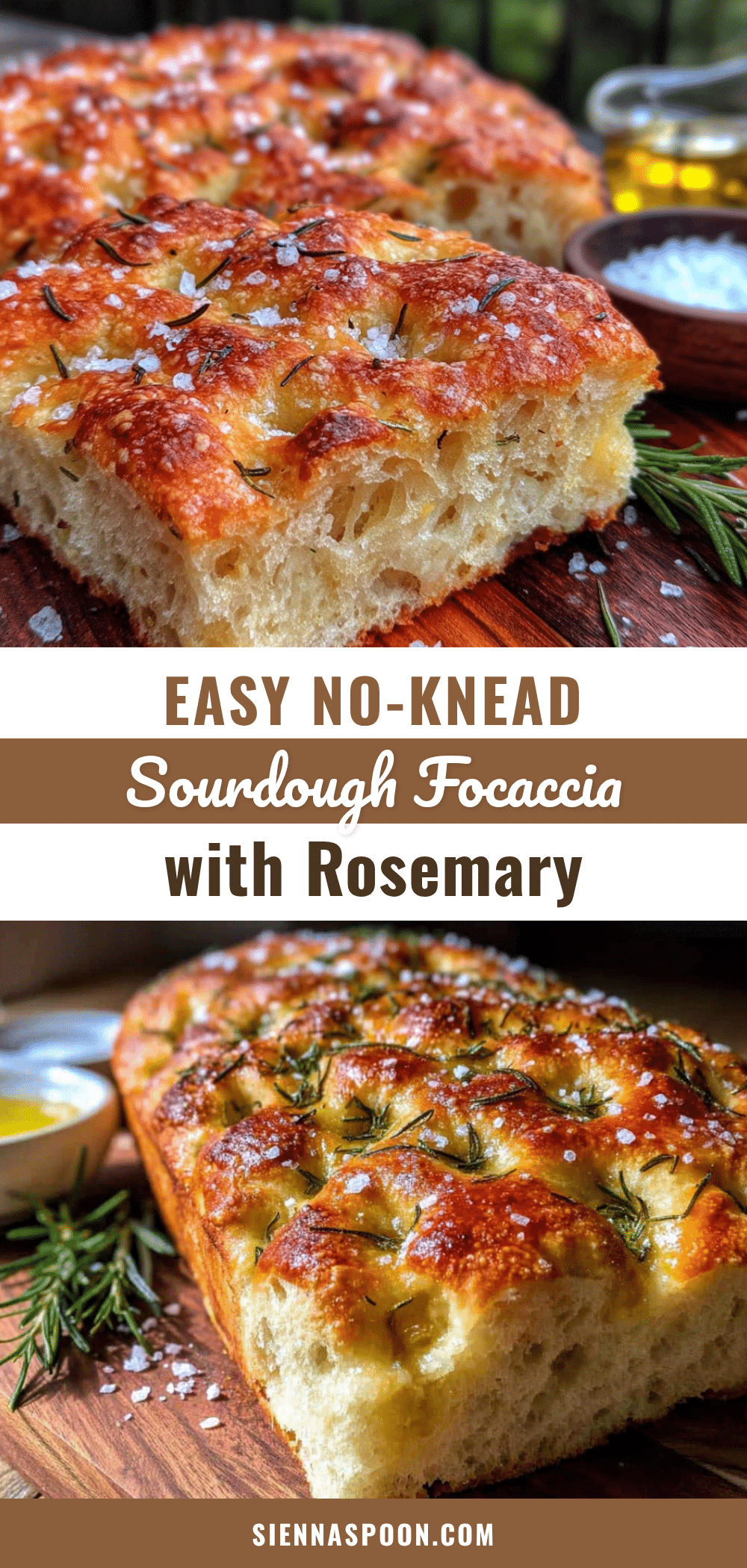
Easy No-Knead Sourdough Discard Focaccia with Rosemary

This easy no-knead sourdough discard focaccia with rosemary is a forgiving, quick, and delicious way to use up your sourdough discard. It features a crispy, olive-oil-crusted exterior and a soft, airy interior, perfect for impressing guests or turning a simple Tuesday into something memorable.
- Prep Time: 15 minutes
- Cook Time: 25-30 minutes
- Total Time: 3 hours 15 minutes (including rising time)
- Yield: 8 servings 1x
- Category: Bread
- Cuisine: Italian
Ingredients
- 3 cups (375g) all-purpose flour
- 1 cup (240g) sourdough discard (unfed, straight from the fridge or room temperature)
- 1 cup (240ml) warm water (90-100°F)
- 1/4 cup (60ml) olive oil, plus more for the pan
- 1 1/2 teaspoons (9g) fine sea salt
- 1 teaspoon honey or sugar (optional)
- 2–3 sprigs fresh rosemary, leaves removed and roughly chopped
- 1 teaspoon flaky sea salt (for sprinkling)
- 2–3 tablespoons extra olive oil (for drizzling)
Instructions
- In a large mixing bowl, combine the sourdough discard and warm water. Stir until the discard is mostly dissolved. Add the olive oil, honey (if using), and salt. Stir again. Add the flour all at once and mix with a wooden spoon until a shaggy, sticky dough forms. Cover the bowl with plastic wrap or a damp towel and let it rest for 30 minutes.
- After the rest, leave the dough covered and let it rise at room temperature for 2-3 hours, until doubled in size and bubbly. Alternatively, refrigerate for 8-12 hours for a cold fermentation.
- Drizzle about 2 tablespoons of olive oil into a 9×13-inch baking pan. Spread it all over the bottom and up the sides. Gently scrape the risen dough into the pan.
- Using oiled fingers, gently stretch the dough to fill the pan. If it resists, let it rest for 5 minutes and try again. Once evenly spread, dimple the entire surface with your fingertips, pressing down firmly almost to the bottom of the pan.
- Cover the pan with plastic wrap or a towel and let the dough rise again until puffy and jiggly, about 30-45 minutes. Meanwhile, preheat the oven to 425°F (220°C) with a rack in the middle.
- Once the dough is puffy, drizzle another 2-3 tablespoons of olive oil over the top. Spread it into the dimples. Sprinkle the chopped rosemary evenly across the surface, followed by the flaky sea salt. Bake for 25-30 minutes, rotating the pan halfway through, until deep golden brown on top and hollow-sounding when tapped on the bottom.
- Let the focaccia cool in the pan for 5 minutes, then transfer to a cooling rack. Let cool for at least 10 more minutes before slicing. Serve warm or at room temperature.
Notes
Don’t overmix the dough; stop as soon as the flour is incorporated. Use room temperature discard for best results. Don’t skip the dimpling—it creates pockets for olive oil. Watch the salt; flaky sea salt is not the same as table salt. Let the focaccia cool completely before storing to avoid a soggy crust.
Nutrition
- Serving Size: 1/8 of recipe
- Calories: 220
- Sugar: 1
- Sodium: 380
- Fat: 10
- Saturated Fat: 1.5
- Carbohydrates: 28
- Fiber: 1
- Protein: 4
Keywords: sourdough discard, focaccia, no-knead, rosemary, easy bread, sourdough recipe